ThE ArK — Public Summary of Concept and Operating Principles
Core positioning statement
ThE ArK is a human-governed, AI-supported civilisational mirror. It gathers early human signals at the point where imagination begins to move toward form, then organises and reflects those signals so human judgement, governance, and project teams can respond before emerging forms become fixed.
Simple operating line: Humans imagine. AI mirrors. Humans judge. Governance acts. Projects carry the work forward.
1. Executive Summary
ThE ArK is proposed as a public-interest system for capturing, organising, and reflecting human imagination before it hardens into major social, technological, institutional, or civilisational form. Its purpose is not to replace human judgement, nor to act as an autonomous artificial intelligence authority. Its purpose is to help humanity see what it is beginning to create.
The central idea is simple: many consequential futures begin as fragments - a proposal, a fear, a shared aspiration, a technical possibility, a cultural trend, a policy pressure, a market signal, or a public concern. By the time these fragments become embedded in law, capital, infrastructure, technology, or identity, they can be difficult to redirect. ThE ArK is designed to operate earlier in that lifecycle.
The ArK core uses relatively basic AI functionality for operational scale: receiving inputs, registering and attributing contributions, routing information, clustering signals, comparing coherence and dissonance, flagging risk or opportunity, and packaging material for human review. It is deliberately framed as non-self-learning at the core. It does not autonomously evolve its own priorities, values, or civilisational agenda.
Human responsibility remains central. Human expert panels, governance bodies, public-interest agencies, institutional partners, and project teams provide interpretation, ethical assessment, policy direction, and action. In this model, AI makes the field visible; humans decide what the field means.
2. Civilisational Transition: Why the Timing Matters
Human civilisation can be understood as moving through a major transition from the industrial age to the information age. The industrial age was organised around factories, production systems, corporations, and the employer-employee relationship. The information age is increasingly organised around AI, automation, data, networks, knowledge flows, and a changing relationship between humans and intelligent tools.
This transition carries immense opportunity. It may expand invention, productivity, education, coordination, creativity, health support, and problem-solving capacity at global scale. At the same time, it may also produce major dislocations: reduced direct corporate employment, weakened social contracts, concentrated ownership of technological advantage, loss of agency, and hardship for people whose livelihoods were built around older industrial structures.
In every major period of civilisational evolution, the central question is not only what humanity can create. It is whether collective wisdom can arrive early enough to maximise opportunity, reduce avoidable hardship, and protect human dignity, participation, and sovereignty during the transition.
Human history has recorded enough suffering to show the cost of leaving major transitions to chance. ThE ArK responds to that lesson by proposing a structured way to gather early human signals before transitional pressures become fixed, hidden, or socially destructive.
3. The Problem ThE ArK Addresses
Humanity can now generate powerful future-forming systems faster than it can collectively examine their consequences. Technologies, markets, settlement ambitions, institutional designs, and cultural movements can move from imagination to implementation with little shared reflection at the emergence stage.
This creates a timing problem. When an idea is still emerging, it is flexible, plural, and open to direction. Once it becomes embedded in systems, law, capital, infrastructure, or identity, it develops its own boundary and momentum. At that point, questioning it can become costly, politically difficult, or socially divisive.
ThE ArK responds to that timing problem by creating a structured mirror at the early stage. It does not assume that every emerging signal is good or bad. It asks what is beginning to form, what coherence it carries, what dissonance it may create, and what human review is required before it moves further toward fixed form.
4. The Lifecycle View
The ArK framework is based on a lifecycle understanding of form. Before boundary, there is undefined potential. When a boundary begins to appear, potential differentiates into form. That form then moves through emergence, growth, stabilisation, fragmentation or decay, and eventual dispersal back into wider potential.
This pattern can be seen in nature. A fertilised cell develops into an embryo and then a newborn through staged differentiation, coherence, participation, and boundary extension. Where the developing system maintains coherence, form stabilises. Where dissonance overwhelms coherence, instability can emerge.
The same pattern can be applied to human constructs. Political systems, economic systems, technologies, corporations, institutions, settlements, and civilisations also become bounded forms. They emerge, grow, stabilise, fragment, decay, and eventually release unused or exhausted potential into new cycles of development.
ThE ArK is designed to enter early in that cycle, while imagination is still alive and before major consequences become locked in.
5. Text-Based Participation and the Digital Boundary
ThE ArK is designed around a simple public-facing input: a bounded, text-based contribution. In its current configuration, this text may be entered directly by key stroke or created through a talk-to-text interface before submission. A person does not need to write a full proposal, hold institutional authority, or possess specialist credentials before their signal can be received. They may submit a short thought, question, warning, hope, need, idea, or imagining.
This creates a unified digital boundary for human participation. Each input enters through the same simple doorway, is calibrated as a thought-sized byte of human imagination, and is then received, recorded, attributed, routed, analysed, sorted, compared, and preserved within the ArK process.
The importance of this design is scale. Billions of people can hold fragments of insight that may never reach institutions, policy processes, research systems, or corporate innovation channels. ThE ArK gives those fragments somewhere to land, while preserving a disciplined internal structure for analysis and review.
Every input is valued as a signal. Not every input will become a project, policy issue, or major discovery. But every input may contribute to pattern, coherence, dissonance, timing, or collective meaning.
6. The Digital Abacus: AI as Efficient Handling, Not Final Authority
ThE ArK does not require frontier-level machine intelligence to perform its core public function. The core technology can be understood as a highly efficient and globally connected digital abacus: a structured information-handling instrument that counts, groups, compares, attributes, and reflects human signals at a scale no manual institution could manage.
This metaphor is useful because it keeps the public meaning clear. The abacus does not decide civilisation. It helps humans see patterns that would otherwise remain scattered, invisible, or too large to handle. In the same way, the ArK core handles scale, routing, clustering, comparison, and preparation. It does not become the author of human meaning.
The system should therefore remain non-self-learning at the core. It should not autonomously evolve its own values, priorities, or civilisational agenda. It remains a bounded tool for humanity, renewed by present human input and governed through human responsibility.
7. Operating Principles
| Principle | Public meaning |
|---|---|
| Human imagination is the primary signal | ThE ArK begins with human contribution: ideas, warnings, hopes, concerns, questions, insights, stories, proposals, and fragments of possibility. |
| AI provides scale, not authority | AI supports registration, attribution, routing, clustering, comparison, pattern recognition, flagging, and packaging. It does not make final civilisational decisions. |
| The core remains non-self-learning | The ArK core is bounded and accountable. It should not autonomously evolve its own intelligence, values, priorities, or agenda. |
| Always in the present | The system is continually renewed by current human input. It reflects the present field of human needs, wants, pressures, fears, hopes, and future aspirations. |
| Attribution is preserved | Contributions should be recorded, traceable, and attributable so participation is respected and, where appropriate, recognised through future value pathways. |
| Coherence and dissonance are both visible | The system does not only search for agreement. It also makes tension, contradiction, risk, omission, and instability visible. |
| Project pathways carry action forward | Where a signal becomes significant, it can move into project status, further review, policy development, public consultation, or specialist investigation. |
8. Architecture and Public Operating Model
The ArK operating model can be understood as a managed flow between contributors, the ArK core, human review teams, governance or policy agencies, approved service users, and project-status pathways. The public-facing system should remain simple at the front door while maintaining disciplined governance behind the scenes.
A contributor submits a byte-sized imagining. The ArK core registers and attributes the input, routes it to relevant pools, compares it with other signals, and identifies possible coherence or dissonance. Where the signal is significant, the material is packaged for human review.
Human review teams may request further prompts, ask for additional processing, identify missing perspectives, test implications, or recommend a project pathway. Public agencies, governance bodies, or approved institutional users may also submit enquiries into the system through service agreements, with outputs governed by public-interest rules and accountability safeguards.
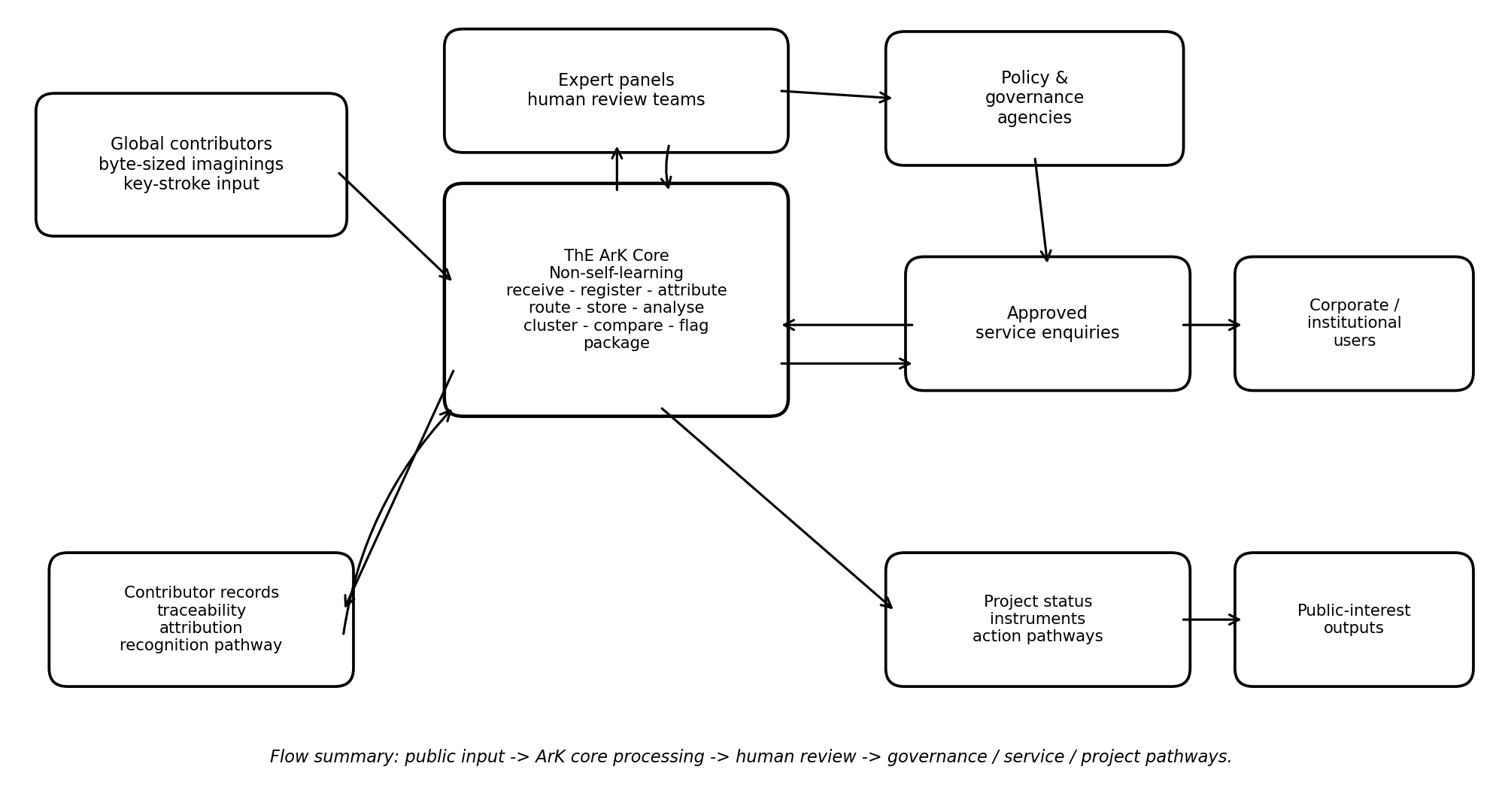
Figure 1. Indicative architecture based on the working sketch: global contributors, the non-self-learning ArK core, expert review, governance interfaces, approved service enquiries, corporate/institutional users under agreement, and project-status pathways.
| Stage | Function |
|---|---|
| 1. Contribution | Individuals and communities submit bounded, byte-sized ideas, concerns, questions, warnings, or possibilities. |
| 2. ArK Core Processing | Inputs are received, registered, attributed, routed, stored, clustered, compared, flagged, and packaged. |
| 3. Expert / Human Review | Human panels interpret meaning, ethics, priority, consequence, risk, opportunity, and possible next steps. |
| 4. Policy / Governance Interface | Relevant public-interest bodies receive structured outputs where a policy, regulatory, or civic response may be needed. |
| 5. Approved Service Enquiries | Approved organisations may request discovery outputs under service agreements and governance controls. |
| 6. Project Status | Significant signals may become tracked projects with continuing review, development, escalation, or action pathways. |
Clean process expression
Receive -> Register -> Attribute -> Route -> Store -> Analyse -> Cluster -> Compare -> Flag -> Package -> Human Review -> Project / Policy Pathway
9. Division of Responsibility: AI and Human Roles
This distinction is a design safeguard. AI can show that something is emerging. Humans decide whether it matters, whether it is valuable, whether it is dangerous, whether it should be developed, restrained, redirected, escalated, or left alone.
| AI operational role | Human interpretive role |
|---|---|
| Scale, Storage, Attribution, Routing, Clustering, Pattern recognition, Signal detection, Coherence and dissonance flagging, Packaging for review, Prompt support for further inquiry | Meaning, Judgement, Ethics, Priority, Wisdom, Consequence, Governance, Action, Accountability, Public-interest responsibility |
10. Governance and Safeguards
For ThE ArK to be credible, it must be governed as a public-interest institution rather than a private extraction platform or autonomous machine authority. Its legitimacy depends on transparency, clear boundaries, privacy protection, contributor rights, auditability, and accountable human oversight.
The ArK core should be deliberately limited. It should not generate its own civilisational agenda. It should not replace democratic process, expert judgement, public consultation, legal authority, or ethical review. It should support those processes by making emerging signals more visible and better organised.
Where commercial or institutional service enquiries are permitted, they should operate under service agreements that protect contributor attribution, data integrity, public-interest obligations, and misuse controls. Where policy or governance agencies receive outputs, those outputs should be clearly framed as structured signal intelligence for human assessment, not automatic policy instruction.
11. What ThE ArK Is - and Is Not
| ThE ArK is | ThE ArK is not |
|---|---|
| A human-governed civilisational mirror | A replacement for human judgement |
| A structured emergence-stage signal system | A prediction engine claiming certainty |
| A digital boundary for key-stroke human participation | An anonymous data-harvesting platform |
| An attribution and routing platform for human imagination | A system that treats public contribution as disposable noise |
| A support layer for expert review, public deliberation, and project development | A self-learning machine authority |
| A way to detect coherence, dissonance, risk, and opportunity early | A system that decides the future on humanity's behalf |
12. Public Value Proposition
| Value | Meaning |
|---|---|
| Earlier visibility | Emerging issues can be detected before they become fixed institutional or civilisational forms. |
| Better participation | People can contribute ideas and concerns without needing to already hold institutional power. |
| Transition wisdom | Large social shifts can be examined through present human needs, wants, fears, hopes, and future aspirations. |
| Improved policy preparation | Governance bodies receive organised signal intelligence rather than fragmented noise. |
| Ethical foresight | Human review teams can examine consequence, consent, sovereignty, and public value before action pathways mature. |
| Innovation discovery | Approved service enquiries can locate patterns of imagination, invention, and possibility across large-scale human input. |
| Contributor recognition | Attribution creates a pathway for participation to be acknowledged and, where appropriate, linked to future reward systems. |
13. Indicative Development Pathway
A public-facing development pathway would likely begin with a limited activation cluster rather than a full global deployment. The first objective would be to test the operating loop: contribution intake, attribution, routing, clustering, review packaging, governance interface, and project-status escalation.
Early pilot streams could focus on a small number of public-interest themes where emerging signals matter: AI and human agency, post-industrial productivity, local resilience, new settlement models, environmental adaptation, or other major civilisational thresholds.
The technical challenge is not only software. The greater challenge is trust architecture: governance authority, contributor confidence, misuse safeguards, public legitimacy, service boundaries, and the clear separation between operational AI support and human decision-making authority.
14. Closing Statement
ThE ArK is proposed as a bounded, non-self-learning, human-governed, AI-supported mirror of emergence. It is designed not to think for humanity, but to help humanity see what it is already thinking before thought becomes form and form becomes fate.
Its value lies in timing. It enters before the idea becomes system, before the system becomes institution, before the institution becomes civilisation, and before the civilisation becomes irreversible.
At its simplest, ThE ArK is a launchpad for human possibility: a way to gather imagination, reveal pattern, preserve attribution, support wisdom, and carry responsible human judgement forward into the futures humanity is already beginning to create.
Appendix: Public Summary in One Page
| Question | Public answer |
|---|---|
| Purpose | To help humanity see emerging future-forming signals early enough for responsible human review. |
| Historical moment | A transition from industrial-age employment and production structures toward information-age AI, automation, data, and new human-tool relationships. |
| Core method | Capture human imagination, organise it through AI-supported processing, and return structured outputs to human review and governance pathways. |
| Public input | A key-stroke, byte-sized imagining: a short thought, question, concern, warning, hope, or proposal. |
| AI boundary | Operational support only: scale, routing, clustering, comparison, flagging, and packaging. No final authority. |
| Human boundary | Meaning, ethics, judgement, priority, action, governance, and accountability remain human responsibilities. |
| Core metaphor | A globally connected digital abacus for human imagination: efficient signal handling, not machine authority. |
| Governance need | The system requires trust, auditability, contributor protection, misuse controls, and clear public-interest purpose. |
| Public promise | Humans imagine. AI mirrors. Humans judge. Governance acts. Projects carry the work forward. |
One-sentence public definition
ThE ArK is a human-governed, AI-supported public-interest system for gathering and reflecting early human imagination so society can examine what it is beginning to create before it becomes fixed form.
Attachment A - Practical Questions and Operating Safeguards
This attachment provides concise answers to common practical questions about ThE ArK, including participation, input handling, contributor benefit, staged development, governance, lifecycle, safeguards, and the role of AI.
1. What is the simplest way to describe ThE ArK?
ThE ArK is a globally connected digital boundary for human imagination.
It receives small human inputs at scale, with each input representing an expressed aspect of future potential. It attributes and protects those inputs, sorts them into coherence pools, detects patterns and tensions, and packages significant signals for human review.
Its purpose is to create pathways from imagination to governance, from concern to inquiry, from signal to project, and from public participation to civilisational response.
In simple terms:
Humans imagine.
The Ark mirrors.
Humans judge.
Governance acts.
Projects carry the work forward.
The app is the doorway.
The cluster is the first working deployment.
The network is the expansion of linked clusters.
The Ark is the whole governed public-interest system.
2. What is ThE ArK ultimately for?
ThE ArK is a tool for unfolding what needs to be managed if humanity is to bring civilisational-scale wisdom to the stewardship of its future.
It does not claim to control the future. It does not replace human judgement. It does not decide what humanity should become.
Its purpose is to help reveal what is emerging early enough for human wisdom, governance, ethics, and responsibility to engage before future forms become fixed.
By gathering small expressions of future potential at scale, ThE ArK can help identify the hopes, fears, risks, opportunities, tensions, and aspirations that are beginning to shape humanity’s next stage.
Its highest purpose is stewardship: to help humanity see what it is beginning to create, and to support wiser participation in what comes next.
3. How can ThE ArK be understood as an operating system?
ThE ArK can be understood as a civilisational operating system for human imagination.
It does not operate society directly. It does not make final decisions. It does not govern humanity.
Its role is to receive, organise, analyse, mirror, and route human inputs so that emerging future potential can become visible before it hardens into fixed form.
At small scale, the Ark can represent possible future pathways emerging from the individuals, communities, institutions, or regions contributing to it.
At larger scale, linked activation clusters can begin to represent broader national and international patterns.
If deployed globally, the Ark could become a living mirror of the possible collective futures of the human species.
It would not claim to know the future. It would show what futures humanity is beginning to imagine, fear, need, desire, warn against, or call into being.
4. What does an Ark input represent?
In Ark terms, each input represents an expressed aspect of future potential.
It may be a hope, concern, warning, proposal, question, idea, observation, or imagining.
Once submitted, it becomes a small but attributable signal of what a human being is beginning to notice, need, fear, desire, question, or imagine.
The Ark does not treat the input as a finished answer. It treats it as a fragment of potential entering form.
When many such inputs are gathered, sorted, clustered, and compared, they may reveal larger patterns of emerging human possibility, pressure, risk, opportunity, or aspiration.
5. How does ThE ArK add value to an input?
ThE ArK adds value by taking a single input and expanding it into a structured future-facing data set.
Each input begins as an aspect of future potential expressed within a single thought-boundary. It may be a question, warning, concern, hope, proposal, observation, or imagining.
The Ark receives that input, preserves it, attributes it, and applies analytical filters to examine how it may contribute to future outcomes.
Those filters may consider positive potential, negative potential, coherence, dissonance, risk, opportunity, urgency, scale, relevance, novelty, repetition, relationship to other inputs, and possible growth, stability, or decay pathways.
The Ark does not alter the original thought. It protects the original input while expanding the field of understanding around it.
As more inputs are received, filtered, compared, and clustered, the Ark can approximate a level of critical mass large enough to reveal patterns that are not only local or individual, but potentially meaningful at community, institutional, national, or civilisational scale.
In simple terms:
A human contributes a thought.
The Ark preserves the thought.
The Ark applies filters.
The thought becomes an expanded data set.
Many expanded data sets are compared at scale.
Patterns of future potential become visible.
Human review then decides what those patterns may mean and whether they require response.
6. How does public participation work?
ThE ArK invites public participation through a simple global contribution interface.
Contributors are not asked to write full proposals, policy papers, inventions, or technical submissions. They are invited to submit short, thought-sized imaginings: ideas, concerns, hopes, warnings, questions, observations, proposals, or possibilities.
The public invitation is simple:
What are you seeing?
What are you concerned about?
What do you imagine might be possible?
What should humanity notice before it becomes too late to change direction?
This allows ordinary citizens, not only experts or institutions, to contribute to the present field of human imagination.
The value comes from scale, diversity, attribution, pattern recognition, and the ability to identify emerging signals across many small human contributions.
7. How does input enter ThE ArK?
ThE ArK, in its current configuration, assumes inputs are received as text.
That text may be entered directly by key stroke, or created through a talk-to-text interface before being submitted.
The important condition is that the input enters the Ark core as a stable text contribution that can be received, attributed, time-stamped, analysed, sorted, clustered, compared, and routed through the system.
8. What is meant by byte-sized input?
The Ark is designed around small, text-based human contributions.
A contribution may be a sentence, phrase, short reflection, question, warning, proposal, or imagining.
The input is deliberately small because the Ark is not intended to store the whole of human life. It is intended to capture trigger-points of imagination: the moment where a thought, need, pressure, hope, fear, risk, or possibility first becomes expressible.
This makes the system scalable, efficient, affordable, and globally deployable.
9. Why does ThE ArK need a user-friendly app interface?
ThE ArK needs a user-friendly app interface because participation should be simple, immediate, and accessible.
For the contributor, the experience should feel as natural as opening an app, entering a thought, confirming it, submitting it, and moving on.
The interface should allow people to contribute when inspiration appears, without needing to prepare a formal submission, write a full proposal, or understand the whole Ark architecture.
A user-friendly interface could allow contributors to:
open the app quickly
type or speak a short imagining
review and confirm the text
submit the contribution
receive simple acknowledgement
access their contribution history
track any future contributor benefit returns
The design principle is low friction.
Open.
Imagine.
Submit.
Move on.
The app is only the doorway. The Ark is the governed system behind it.
10. How does the contribution flow work?
The basic contribution flow is:
A human contributor submits a byte-sized imagining.
The Ark receives the input as text.
The input is registered, attributed, and time-stamped.
The input is preserved in its original form.
The Ark applies analytical filters.
The input is routed into relevant coherence pools.
The input is compared with related contributions.
Patterns, tensions, repetitions, dissonance, risks, opportunities, and emerging signals are identified.
Significant outputs are packaged for human review.
Where appropriate, material is escalated into project status, policy review, public-interest research, institutional response, or service-agreement pathways.
In simple terms:
Human input enters.
The Ark preserves and processes it.
Patterns become visible.
Human review interprets.
Governance decides.
Projects carry the work forward.
11. How does benefit return to contributors?
The Ark economy is based on the principle that human imagination has value.
Where contributed inputs materially assist a successful enquiry, project, research pathway, innovation, policy development, public-interest intervention, or service outcome, contributors may receive fractionalised benefit returns.
These payments would not usually operate as large rewards for isolated ideas.
They would recognise that value often emerges from many small contributions forming a coherent pattern.
Benefit return may therefore be fractionalised across many contributors whose inputs helped form a useful pool of insight.
This protects the collective nature of the system while still recognising individual participation.
12. How could ThE ArK become economically self-sufficient?
ThE ArK could operate through a mixed public-interest economy.
Potential revenue pathways may include public-interest sponsorship, institutional service agreements, research access agreements, policy and governance enquiry services, corporate innovation or risk-review services, philanthropic support, grants, project-based commissioning, and licensed analytical outputs under strict governance rules.
The aim is not to create a conventional profit-maximising corporation.
The aim is to create an operationally self-sufficient public-interest system able to cover infrastructure, security, attribution, contributor returns, governance, audit, human review, and project development.
Surplus should be held within the Ark’s founding purpose and reinvested into the system, contributor economy, public-interest projects, and long-term civilisational benefit.
13. How much would it cost to build ThE ArK?
The cost depends on the scale of activation and the grade of service required.
A proof-of-concept model would be a controlled test environment. It would not attempt global deployment. Its purpose would be to demonstrate the core Ark process with a limited user group, limited contribution volume, and a basic review pathway.
Under the Ark technical estimate, a proof-of-concept phase may require approximately US$500,000 to US$1.5 million over 6 to 9 months.
This investment should not be regarded as a lost or throwaway cost.
The proof-of-concept would create core assets that can be built upon in the next stage, including the early contribution interface, user registration model, input capture process, attribution framework, storage architecture, filtering logic, coherence-pool structure, review workflow, reporting dashboard, and initial governance controls.
The proof-of-concept should be tested across normal public access points, including:
mobile app interface for Android
mobile app interface for iOS
laptop and desktop web interface
direct key-stroke text entry
talk-to-text input before submission
basic contributor registration
input attribution and time-stamping
secure storage of original inputs
AI-assisted filtering, sorting, and clustering
basic coherence-pool creation
sample human review workflow
limited reporting dashboard
early safeguards against duplication and misuse
In user terms, a proof-of-concept may be designed for approximately 500 to 2,000 controlled test contributors, with enough system capacity to test immediate input acknowledgement, basic user experience, input handling, attribution, filtering, clustering, and review workflows.
The proof-of-concept would prove the operating logic, not population-scale performance.
Beyond proof-of-concept, ThE ArK would require a serious first activation phase.
Under the Ark technical estimate, the Stage One Activation Cluster is proposed as an approximately 24-month development and testing phase requiring about US$10 million.
The Stage One Activation Cluster would build on the proof-of-concept assets and expand them into a working public-interest deployment with a higher grade of service. It would be designed to support meaningful user connection, reliable contribution capture, immediate system response, secure attribution, scalable data handling, automated filtering, human review workflows, governance reporting, misuse monitoring, and early contributor benefit accounting.
In user terms, Stage One may be scoped to test up to approximately 50,000 to 100,000 registered contributors within one activation cluster, with capacity for regular active participation, immediate acknowledgement of submitted inputs, and scalable processing of a substantial contribution pool.
The grade of service should distinguish between two responses:
Immediate system response: the contributor receives confirmation that the input has been received, attributed, and preserved.
Analytical system processing: the Ark then applies filters, expands the input into a future-facing data set, routes it into coherence pools, and prepares outputs for review.
Stage One should be measured against practical service standards, including:
stable access through Android, iOS, laptop, and desktop interfaces
direct key-stroke and talk-to-text contribution pathways
immediate acknowledgement that an input has been received
secure attribution and preservation of the original contribution
timely conversion of each input into an expanded data set
routing into relevant coherence pools
system monitoring of input volume, duplication, distortion, and participation trends
dashboard reporting for review teams and governance bodies
capacity to identify significant emerging signals for human review
The cost estimates are not final costs or commercial quotes.
They are indicative planning estimates for staged development: first, to build reusable proof-of-concept assets and prove the Ark process in a controlled environment; then to scale those assets into a working activation cluster capable of testing ThE ArK as a civilisational mirror under real participation conditions.
14. How would ThE ArK grow from one cluster to a global network?
ThE ArK should not be imagined as a single global system built overnight.
It should grow through activation clusters.
Each cluster would create a level of benefit. Even one cluster could gather useful public input, detect emerging patterns, test governance settings, support project review, and demonstrate practical value.
As more clusters are built, the collection pool becomes broader, the pattern field becomes richer, and the sphere of public-interest influence grows.
The development pathway would move from proof-of-concept, to closed pilot, to Stage One Activation Cluster, to multi-jurisdiction trial, to international governance layer, to global public-interest deployment.
Like the internet, the Ark would grow through linked systems, shared protocols, institutional support, public trust, and practical usefulness over time.
15. What is the main rollout risk?
The main rollout risk is not primarily technical.
The core technologies required for early operation already exist in broad form. The larger risk is political, institutional, and governance-based.
There are two main forms of capture risk.
The first is direct capture, where a government, corporation, ideology, market interest, or technical provider gains controlling influence over ThE ArK.
The second is structural fracture, where competing jurisdictions or organisations create rival systems that duplicate or compete with the Ark rather than support a unified public-interest framework.
This second risk may be the more serious.
ThE ArK’s value depends on unity of purpose, shared protocol, common governance principles, and the growth of a universal collection pool.
If the system fractures, each separate version may still produce useful outputs for those within its own field of influence. It may still serve the people, institutions, or jurisdictions whose voices are included through input participation.
But it could no longer confidently operate as a system inclusive of all humanity.
Its outputs would remain meaningful to those who participate, but they would no longer represent the widest possible collective field of human imagination.
Competing systems would also create bias and distortion risks. Separate pools of contribution would produce separate sample fields. Those fields may then generate conflicting outputs, not because one system is necessarily technically wrong, but because each is listening to a different participant base.
In that condition, the Ark would fall back into being a research tool at best.
It would become more like competing opinion research systems, where different samples, methods, sponsors, and participant pools can produce different claims about public intention.
That is not the Ark’s highest purpose.
For that reason, ThE ArK cannot become just another competitive platform. Its value depends on being held as a unified civilisational instrument.
Global rollout should therefore be sponsored through national-interest and public-interest channels, not left to free-market self-interest or jurisdictional competition.
The central issue is not only whether the Ark can be built. It is whether it can be hosted, protected, governed, trusted, and kept whole.
16. What safeguards prevent distortion for financial gain?
A system that rewards contribution must expect attempts at distortion.
ThE ArK would therefore require safeguards against duplication, organised gaming, automated flooding, synthetic participation, coordinated manipulation, and low-originality mass input.
Safeguards may include fractionalised payments, dilution of duplicated or low-originality inputs, account monitoring, detection of repeated phrases or bot-like behaviour, review of high-value reward pools, account-level thresholds, human audit, and transparent reporting of distortion risks.
The aim is not to punish genuine resonance.
Many people may independently imagine similar things at the same time. That may be the signal the Ark needs to detect.
The safeguard is against artificial distortion designed to manufacture false resonance for financial gain.
17. How is governance protected?
ThE ArK would require a governance structure designed to protect its founding principles.
Those principles include human benefit, non-capture, non-fracture, non-self-learning core operation, transparency, attribution, privacy, public-interest purpose, and the clear separation of AI processing from human judgement.
Governance must protect the Ark from political, corporate, ideological, national, commercial, or technical capture.
It must also protect the unity of the system so that ThE ArK does not fracture into competing platforms or biased collection pools.
A possible structure would include a peak board of trustees responsible for the founding purpose, with national trustee boards acting as interfaces between ThE ArK and each host jurisdiction.
National trustee boards would not own or redirect the Ark.
Their role would be to support lawful operation, public trust, local compliance, national reporting, and proper interface with host governments, institutions, and communities.
The Ark itself would remain governed by its founding purpose and operating principles.
18. Could ThE ArK be established as a perpetual trust?
The preferred concept is that ThE ArK be created as a perpetual-purpose public-interest structure, or equivalent legal form, designed to continue across generations.
The intention would be to prevent the Ark from being sold, privatised, captured, redirected, or converted into an ordinary commercial asset.
However, the precise legal structure would require specialist advice across trust, charity, treaty, corporate, and international law.
The public principle is clear:
ThE ArK should not belong to a government, corporation, political party, private founder, commercial shareholder class, or single national interest.
It should be held in trust for humanity’s continuing capacity to imagine, reflect, and govern its own emergence.
This does not mean the Ark should pretend to exist forever.
It means the founding structure should protect the Ark for as long as it remains coherent, useful, trusted, and aligned with its public-interest purpose.
19. Would ThE ArK also be subject to lifecycle?
Yes.
ThE ArK would also be subject to lifecycle.
Although it may be established as a long-term public-interest structure, it should not pretend to sit outside the natural pattern of emergence, growth, stability, decay, and dispersal.
The Ark itself would be a bounded form.
It would emerge through human imagination, governance, technology, participation, funding, law, trust, and civilisational need.
It would then grow, stabilise, adapt, and continue only while it remained coherent with its founding purpose and useful to humanity.
For that reason, the founding design should allow not only for continuity, but also for eventual decay and dispersal if the Ark’s purpose is exhausted, its operating conditions no longer exist, or humanity evolves beyond the form it was created to serve.
This does not weaken the Ark. It strengthens it.
A system designed to recognise lifecycle should also recognise its own lifecycle.
The purpose is not to preserve the institution forever at any cost.
The purpose is to preserve the founding intention for as long as it remains coherent, useful, trustworthy, and aligned with civilisational stewardship.
If the Ark one day completes its purpose, loses coherence, or is superseded by a more appropriate form, its remaining knowledge, assets, obligations, and public-interest value should be dispersed according to predetermined founding principles.
20. How does the Ark’s self-diagnostic process relate to lifecycle?
The Ark’s self-diagnostic process is a direct expression of its lifecycle reality.
Because ThE ArK would itself be a bounded form, it would need to monitor its own emergence, growth, stability, tension, decay, and possible dispersal.
The purpose of self-diagnosis is not to give the Ark autonomous authority. Its purpose is disclosure.
The Ark should be able to report the internal state of the total system, including its coherence, tension points, distortion risks, participation patterns, review pressures, governance issues, and areas requiring attention.
This reporting would allow trustees, governance bodies, review teams, and public-interest partners to see where the system is healthy, where it is under pressure, and where intervention may be required.
For example, variations in input volume may be significant.
Rising input volumes may indicate public engagement, emerging concern, increased relevance, or heightened civilisational pressure.
Declining input volumes may indicate reduced public trust, reduced usefulness, poor interface design, contributor fatigue, lack of perceived benefit, weak public engagement, or declining attractiveness of participation.
If declining inputs became sustained, they could operate as a terminal indicator of reduced human contribution attractiveness.
That would require review.
Possible responses might include improving the user interface, strengthening public communication, issuing new prompts, increasing transparency, adjusting contributor reward settings, improving benefit return pathways, or reviewing whether the Ark remains aligned with its founding purpose.
In this way, self-diagnostic reporting helps the Ark remain accountable to its own lifecycle.
It allows the system to disclose where coherence is strong, where tension is forming, where participation is weakening, and where stewardship action may be needed.
21. How automated would the Ark be?
Much of the Ark’s daily workflow would be automated.
AI-supported systems would receive inputs, register contributions, apply filters, route material, identify patterns, raise work orders, prepare review packets, monitor system status, and generate reporting for governance and review teams.
Automation would be used for scale, speed, consistency, and efficiency.
Human support would be called upon where interpretation, ethical judgement, dispute resolution, specialist knowledge, governance action, legal review, or public-interest decision-making is required.
The purpose of automation is efficiency. The purpose of human governance is responsibility.
22. Why is the Ark non-self-learning?
The Ark core should be non-self-learning because its role is not to become an autonomous intelligence.
Its role is to operate as a governed civilisational mirror.
It may receive, process, sort, cluster, compare, flag, and report.
But it should not independently evolve its own values, purposes, civilisational preferences, or decision-making authority.
This boundary protects the Ark from becoming the future’s author.
AI participates in the Ark as a tool of service, scale, pattern recognition, and system support.
It is not the master of the system.
Human imagination provides the signal. Human governance carries responsibility. The future remains a human responsibility.